The word sosai (蔬菜) is an old Japanese term for vegetables grown by human hands — tended with care, coaxed from the soil. Not wild plants that appear on their own, but something shaped by someone’s intention and labour. Once you eat here, the choice of name makes complete sense.
The whole vegetable. Every part of it.
The offcuts, the leaves. The pieces that would normally be trimmed and thrown away become soup, become sauce. A vegetable charred and fragrant from the fire arrives at the table as the centrepiece of the meal.
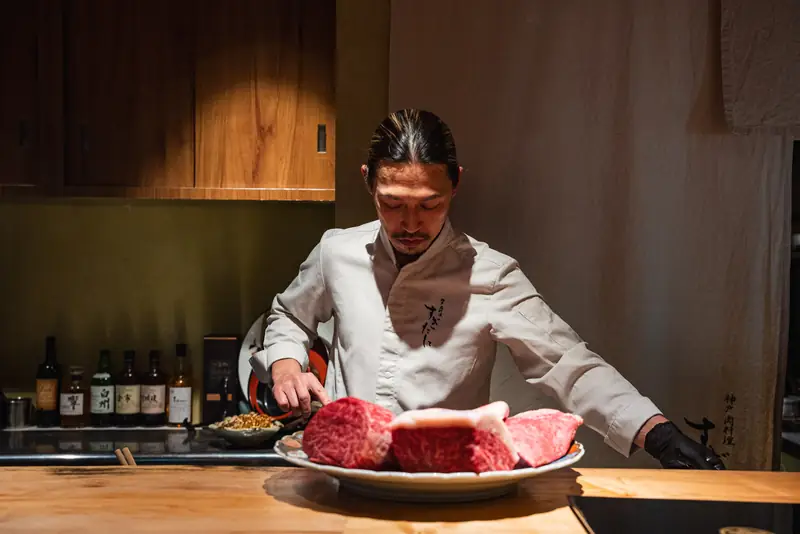
“People still think of vegetables as cheap,” says Yonemura-san, the restaurant’s manager, speaking from behind the counter. “But they’re genuinely nutritious, and there may come a day when we can’t take them for granted anymore. I want to communicate that essential truth — that vegetables deserve to be eaten with care.”

“I” and “You” — and Then Canada
Yonemura-san started working in construction at sixteen. It was in his early twenties that he made the leap into kitchens — drawn there, he says, by the invisible influence of watching his mother work in hospitality his whole life. It had seeped in without him realising.
After two years at a kappo restaurant, he flew to Canada. His English amounted to roughly “I” and “you.”
“I couldn’t even ask where to buy daikon in English.”
He walked into a Japanese restaurant with seating for 170. The deal he struck: he’d teach cooking, they’d teach English. Learning the language while learning how a full-scale restaurant runs, he stayed and contributed to its operation.
But what he witnessed there struck him as fundamentally different from Japanese kitchen culture. Separate chopping boards for meat, fish, and vegetables. Different knives for different purposes. Things that were simply obvious in Japan turned out to be far from standard there.
“The attitude was sort of — if you open somewhere, customers will come. That didn’t sit right with me, and in the end, I got fired.”
But fortune intervened. Another Japanese restaurant hired him, sponsored his visa, and he spent two years working in Canada.

“If You’re Just Using Us for Business, Don’t Bother”
Back in Japan, Yonemura-san built his experience at affiliated restaurants — Stand COBE and Kyo Koinobori — before turning his focus to opening Sosai. Without knowing quite where to begin, he started cold-visiting farms. Through a chain of introductions, he eventually found his way to a producer called Healthy Mama SUN.
“The son has taken over now, but the mother was extraordinary — she’d go around kindergartens and primary schools giving talks, she’d even been commended at the Imperial Palace. These days people say you shouldn’t eat anything that’s fallen on the ground, but she’d say: wipe off the soil and eat it, the bacteria will live on inside you. Hearing her speak was a genuine education.”
At Healthy Mama SUN’s farm, she asked him a direct question.
“What’s your end goal? Why do you want to use our vegetables? If you’re just going to treat them as a business tool, don’t bother.”
Yonemura-san’s answer was this: he wanted to carry the voices of producers — voices that so rarely reach consumers — and bring them to the table.
“When our intentions matched, she said: use them. She told me that the thing she’s most grateful for is someone conveying what the producer feels. That moment is what made me think — this is genuinely meaningful work.”

What the Name Carries
Sosai (蔬菜) — the name chosen for the restaurant — refers specifically to vegetables grown by human hands. Not what springs up on its own, but what carries someone’s will and work. The logo uses the Japanese map symbol for a rice paddy as its motif.
“We’re using vegetables, so it felt right to put that into a symbol.”
Simple words, but underneath them sits a clear awareness: what we serve here was grown by someone. Pesticide-free, organic, domestically sourced — the team holds to those standards as much as possible, sourcing primarily from farms in Hyogo Prefecture, with origin-specific choices like asparagus from Kagawa.

A Building That Survived the Earthquake, Remade by Hand
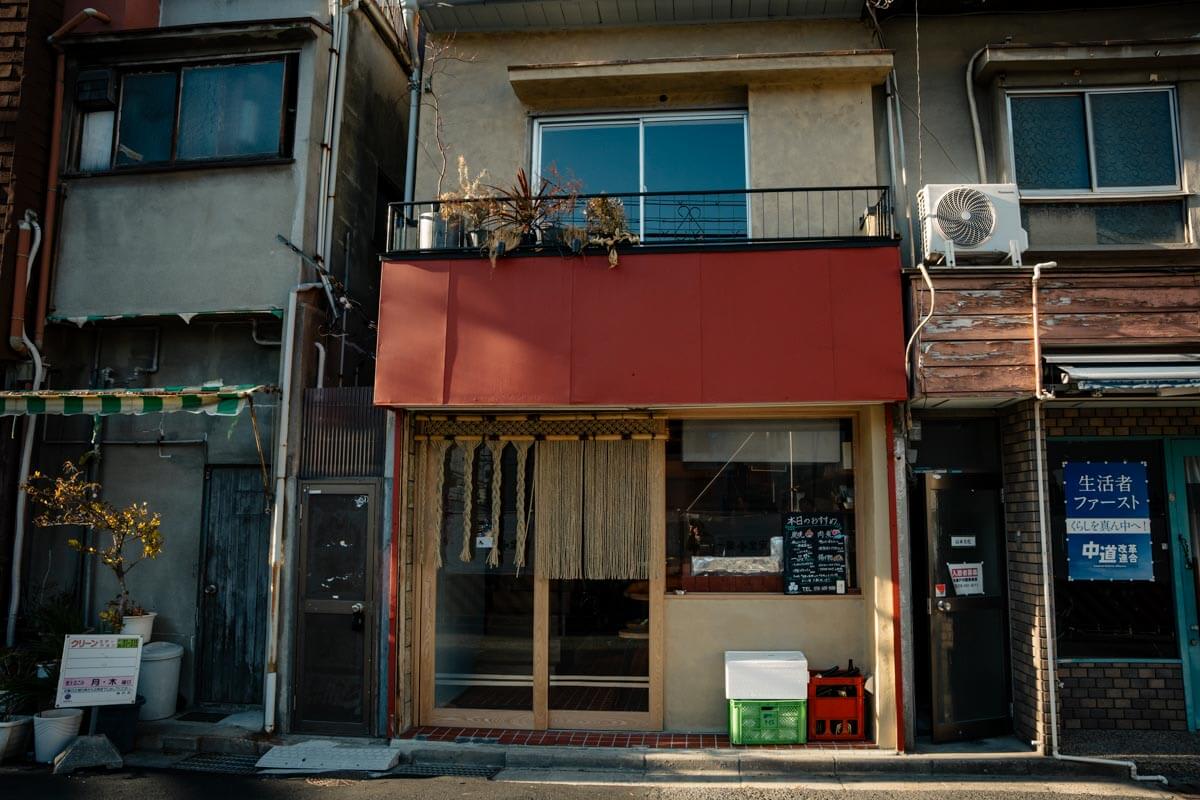
The location is Ninomiya — chosen with an eye on how the city’s centre of gravity has been shifting east from Sannomiya.
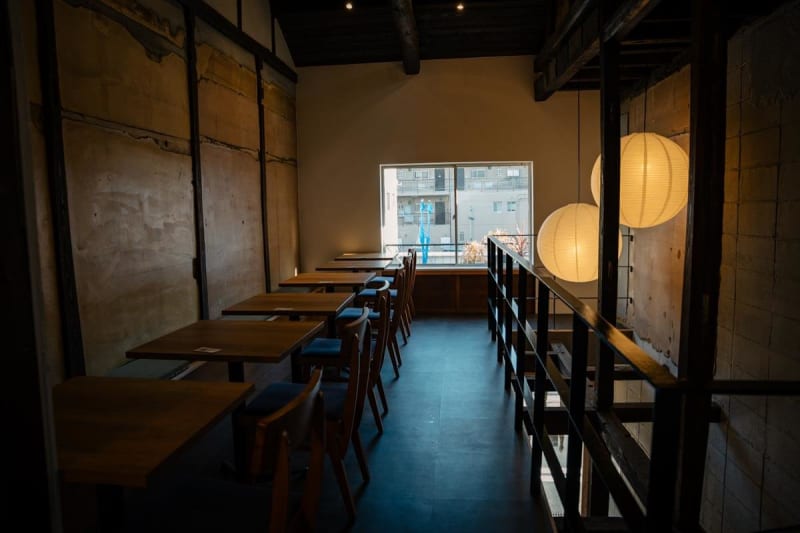
The ground floor holds around eight counter seats. You watch the charcoal catch light, watch dishes come together right in front of you. Upstairs, table seating makes it easy for a group of friends to settle in for an unhurried evening.
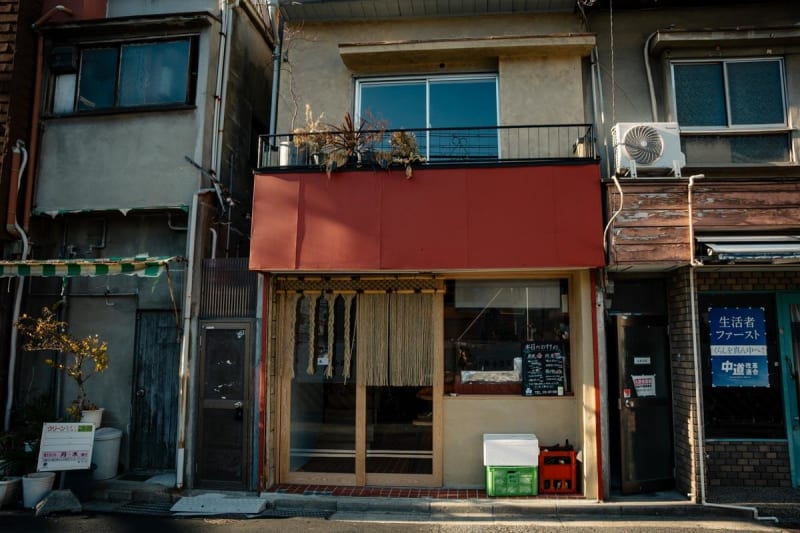
The building was previously a hair salon, and it has stood through the Kobe earthquake. Yonemura-san and the team took it apart and rebuilt it with their own hands.
“We originally planned to go with a stripped-back skeletal look, but some of the pillars were shifting, so we ended up having to redo things from the foundations up.”
Every door frame was planed down by hand. A contact was commissioned to build the fittings. The yakisugi — burnt cedar — on the walls was charred and finished by the team themselves.
“The plumbing, the electrical work, the carpentry — almost all of it was done by the owner’s classmates who came to help.”
Yonemura-san’s background in construction meant he was right at home: planing glass that wouldn’t fit, thinking through the flow of movement and laying out the space accordingly. The property was acquired in April of last year; the restaurant opened on 9 December 2025, after more than six months of training, research trips, and taste-testing.
“There are still rough edges, but I think that’s part of what gives the space its character.”

Charcoal and Vegetable, Together on a Plate
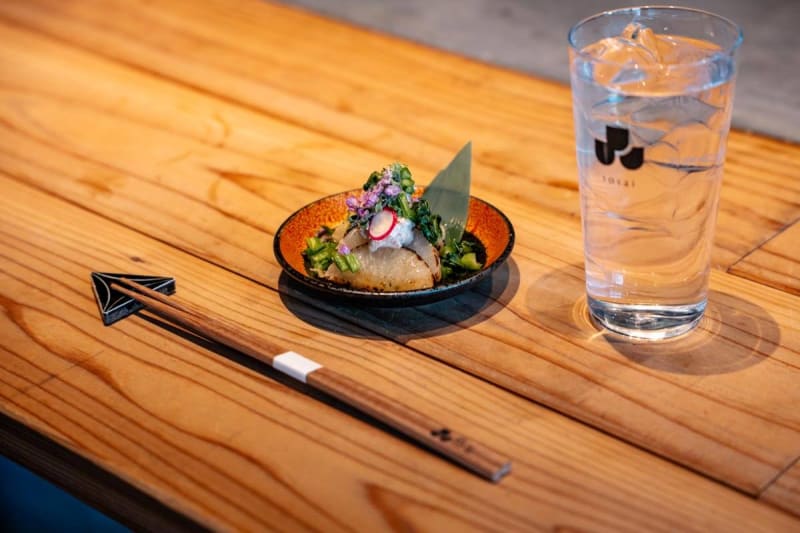
The cooking centres on the charcoal grill. The dish we tasted: daikon simmered first, then placed over charcoal, then finished with a house-made charcoal oil to give it its aroma.
“Vegetables have no fat, so they don’t generate smoke. They don’t pick up char naturally, so we add the charcoal oil for fragrance.”
The charcoal-grilled daikon comes topped with a sauce of crab and mascarpone. The first bite brings smokiness and the gentle sweetness of the daikon together; then the richness of the cheese and crab layers over it. A combination that has no precedent. And on top of the plate: the daikon leaf — what would normally be trimmed away and discarded — placed there as the finishing touch.
Making the Restaurant an Aspirational Place to Work
Yonemura-san has one more thing he wants to put into the world.
“I want more people to want to work in restaurants.”
The reputation sticks: long hours, low pay. But strip that back and there’s still a great deal to find rewarding. The maths of running a business, sourcing ingredients, serving guests, physical work. A job where the more you do, the more you accumulate.
“It might be the profession where the most learnable things are concentrated in one place. There’s something human to learn from it too, I think.”
There’s also a desire to lift the whole neighbourhood, not just the restaurant. The bar-hopping event “Vamos Ninomiya,” planned for 22 March, is part of that. A chance, Yonemura-san hopes, to begin changing the perception that hospitality equals overwork.
The Night the Vegetable Takes Centre Stage
A quiet presence tucked into a Ninomiya lane. Charcoal smoke drifts through the air; behind the counter, vegetables are being tended to the fire with patience and precision.
Through every carefully cooked dish, something of the producer’s world is passed to the person eating it. The seeds Yonemura-san has planted are taking root — quietly, steadily, in Kobe.

蔬菜-sosai-
- 📍 3-2-7 Ninomiyacho, Chuo Ward, Kobe, Hyogo
- 🚃 6-min walk from JR Sannomiya / Kobe Municipal Subway Sannomiya · 8-min walk from Hankyu/Hanshin Kobe-Sannomiya
- ⏰ Tue–Sun 17:00–23:00 (L.O. 22:30)
- 🗓 Closed Mondays
This article contains affiliate links.