
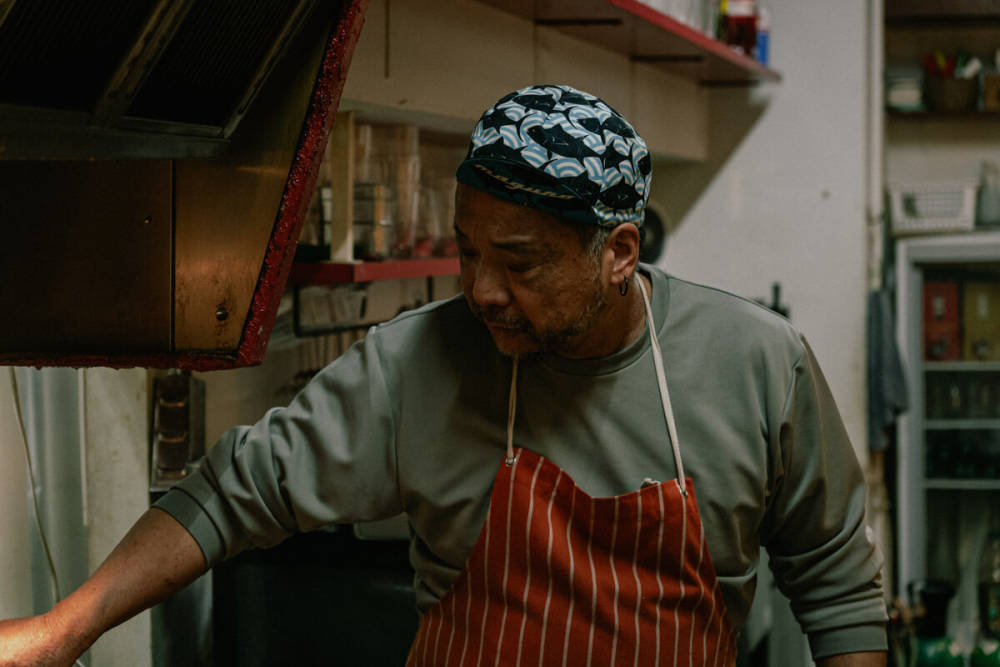
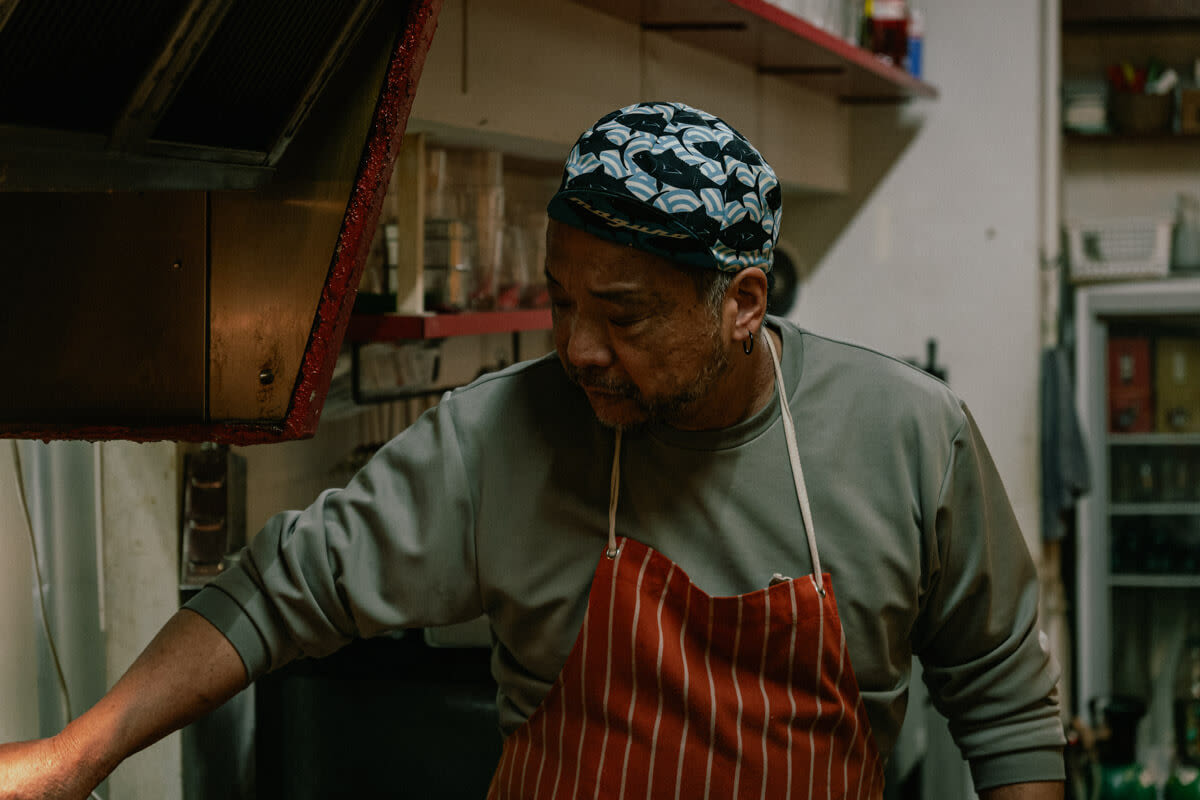
Zero cooking experience when he opened. In the first year, food couldn't make it out of the kitchen and customers walked out. The story of owner Tokutomi, who never gave up — and how he became the name people say when someone says "chicken nanban" in Kobe.
No table of contents available
Author
Naoki Nakayama
Passionate about sharing stories and experiences through thoughtful writing.
An hour and a half after ordering, the food still hasn’t arrived.
Golden Week, peak season. The restaurant is packed. But the person standing in the kitchen has almost zero cooking experience. The place just opened, it’s been featured in magazines, customers keep streaming in. But the food isn’t coming out.
All he could do was watch as people got up in frustration and left.
“Money, people — nothing but failure.”
Owner Tokutomi says it across the counter, and laughs.
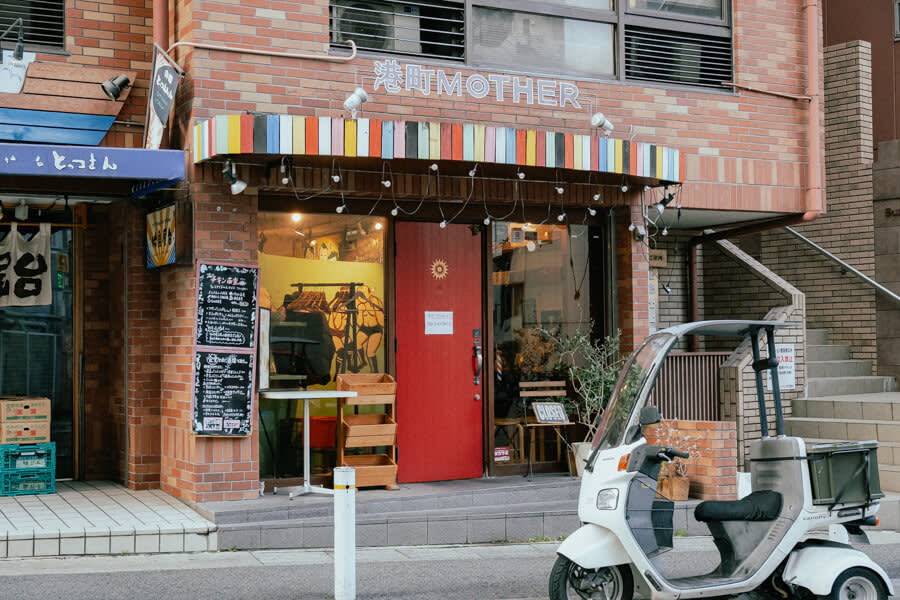
The restaurant has been here for 26 years. Today it’s the place Kobe people think of first when someone says “chicken nanban” — lines form out front. But the road to get here was one failure and stumble after another.
This is Tokutomi’s story: 26 years on Ninomiya, in food and drink.
Food That Wouldn’t Come Out, Customers Who Left. The Desperate First Year.
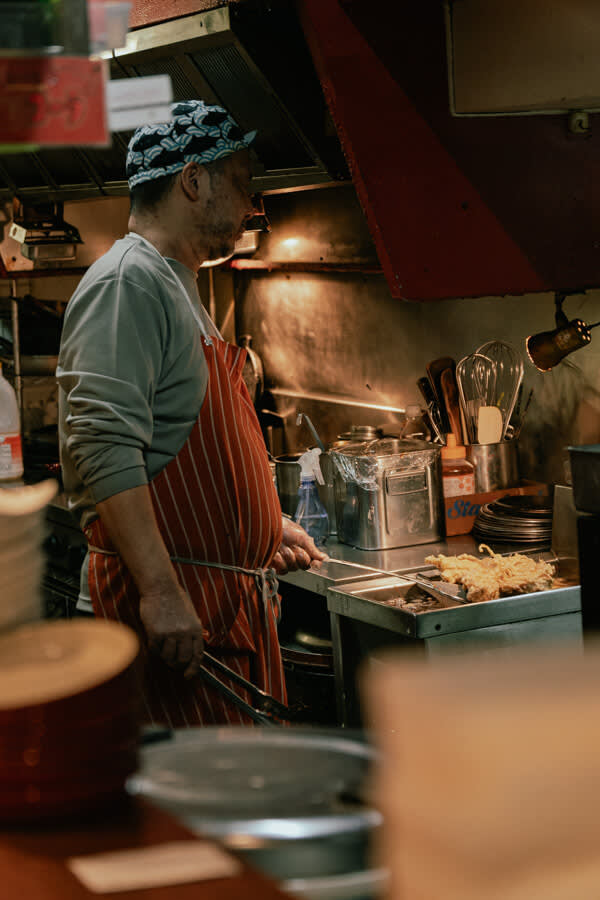
Before opening in Kobe, Tokutomi spent three or four years in Osaka as a restaurant manager — overseeing staff, reading numbers, running operations. That experience made him think he could handle it.
At 29, he opened his first restaurant in Kobe.
“I opened as the owner with a cook I hired, without being able to cook myself.”
The plan was to enjoy himself while leaving things to the chef. But reality had other ideas. Before a year was out, the hired cook had left.
“Quit before a year. I figured, I have to do this myself — using other people just isn’t going to work.”
The cruelest part: they quit right before Golden Week. High season, no chef.
“From Golden Week, I was alone. And I couldn’t get the food out. It was still our first year, we’d been in magazines, so customers were coming in. And every one of them became a complaint.”
Food that didn’t come out. Angry customers walking out. New customers arriving, and still the food wouldn’t come out.
“It was rough. If there’d been something like Tabelog back then, we would’ve been done in a year.”
No social media was the saving grace. He wasn’t entirely without cooking experience, but he was close to a beginner. The second year — when he slowly started teaching himself to cook — was where the real story began.

The Day a Restaurant With No Identity Found Its Calling
“Even part-timers couldn’t explain what kind of restaurant it was when customers asked.”
For the first two years or so, there was no clear concept. No signature. No hook.
Something had to change — and right around that time, word started spreading through the neighborhood: the chicken nanban here is good.
“Customers were coming in based on word of mouth, saying the chicken nanban was great. There weren’t any other places around here doing it, so I figured — if we go all in, we can be number one.”
In the third year, chicken nanban became the signature dish.
“There are places that try to do chicken nanban, but a surprising number close. It doesn’t stick. It’s more involved than karaage — there are extra steps in between.”
Labor-intensive. Which is why others give up. And that, it turned out, was the opportunity. Now he had a flag to plant. The question was just how far he could push the flavor.
The Moment the Flavor Clicked — One Staff Member’s Comment
He’d been using regular Kikkoman soy sauce. Adding sugar to adjust the sweetness. Something always felt off — “it never quite lands” — when a part-time worker from Kyushu said something.
“Why aren’t you using Fundokin?”
Fundokin — a sweet soy sauce that’s a staple in virtually every Kyushu household. At the time, it was barely distributed in the Kansai region.
“Down there, every house has it without fail. It’s incredibly sweet — even the non-sweet versions are sweet.”
He ordered it online and tried it. In that moment, everything changed.
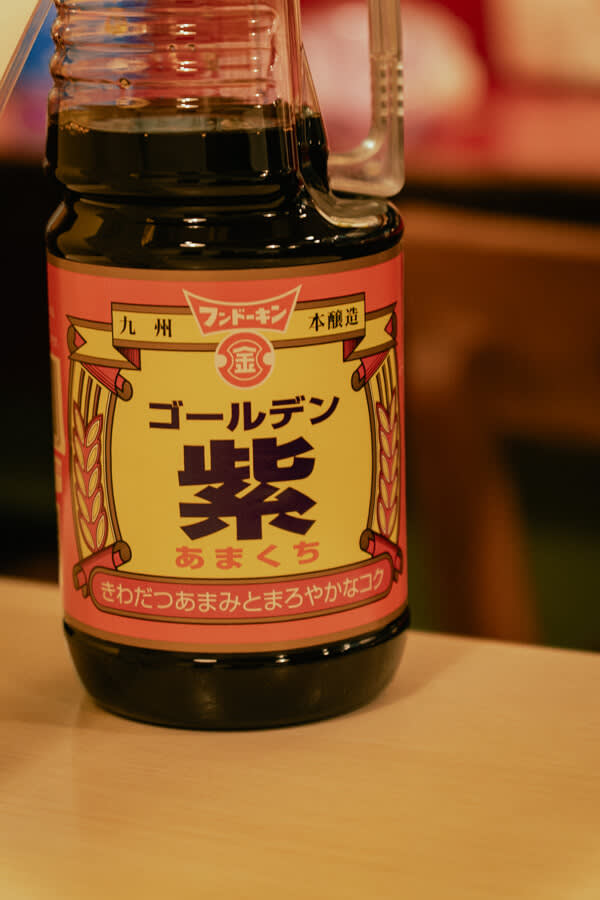
“With this, you don’t need to add sugar. Before, I was using regular Kansai-style soy sauce, which is salty, so I’d add sugar. But something never clicked. The moment I used this, it all fell into place.”
It clicked.
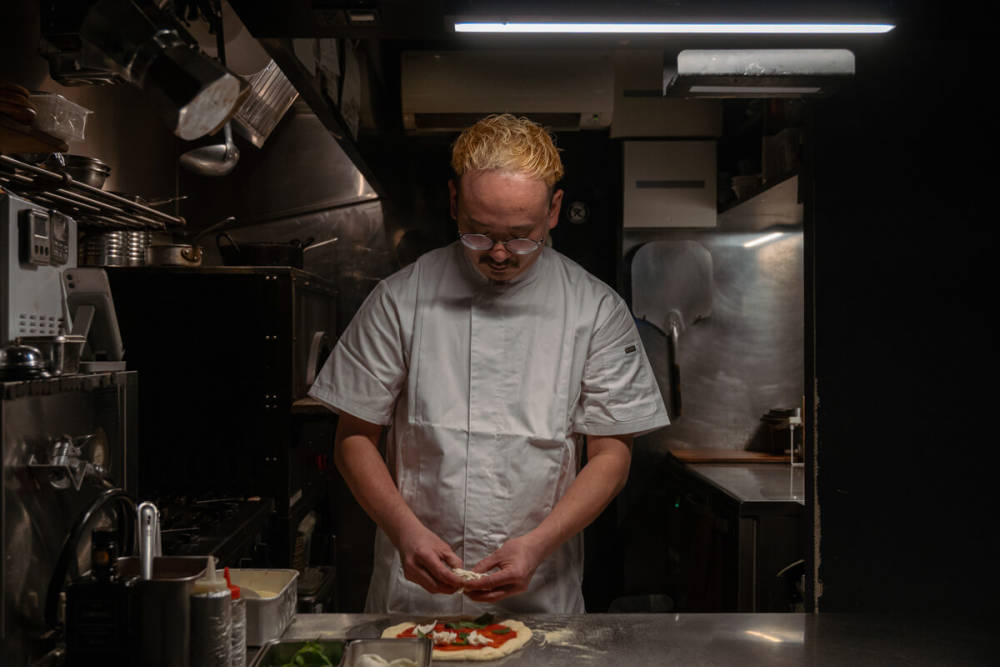
The sauce — built on Fundokin sweet soy — wraps itself around the hot chicken. House-made tartar sauce piled generously on top, fresh vegetables adding color and contrast.
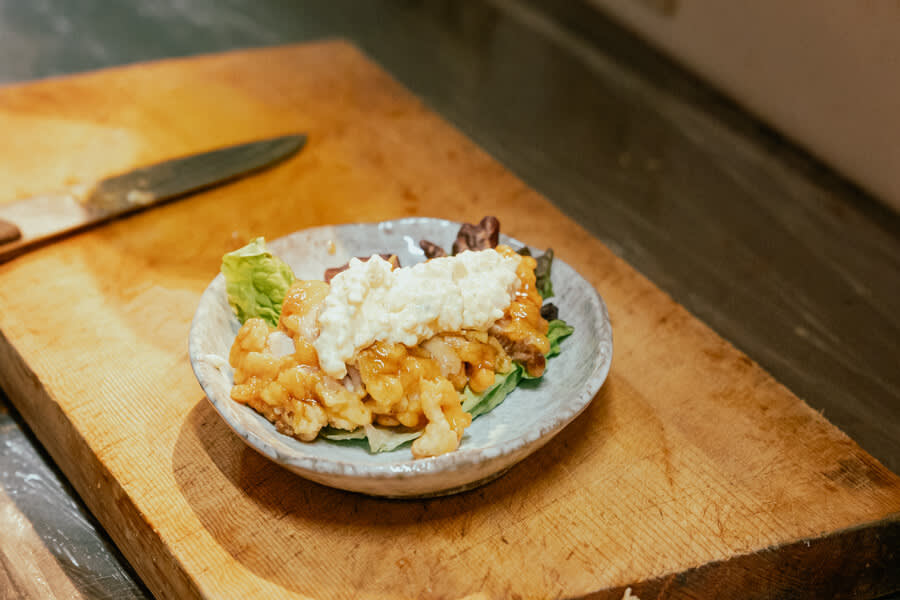
One bite, and you hit a surprisingly juicy interior. The sweetness draws out the chicken’s umami, and the tartar sauce wraps everything in gentle roundness.
Chicken nanban is originally a Kyushu dish. So: a Kyushu soy sauce. That’s how Minatomachi MOTHER’s flavor was born.
Five Years to Fill the Lunch Tables
Even after settling on a signature and nailing the flavor, customers didn’t immediately come flooding in.
“Lunch wasn’t completely empty — I’d get one or two — but that was it. I was still single then, so I could just about manage.”
Five years until lunch was regularly full. In the early days, some afternoons only brought a handful of people through the door. But he didn’t quit. He talked his way into a friend’s French kitchen on days off, and had regulars at popular izakayas show him tricks of the trade. Little by little, he learned.
“Honestly, I’m glad there was no social media.”
He says it looking back from the kitchen. In his eyes, you can see the weight of those years.

Ties to the Neighborhood
Every year on May 4th, Ninomiya carries a portable shrine. The number of carriers has been shrinking.
“There used to be 70 people at its peak. Now it’s down to 30 or 40. Everyone’s groaning about how hard it is — but if the local shop owners just took that one afternoon off and showed up, there’d be plenty of people.”
Tokutomi himself carried debt and went through some hard stretches. But once he started joining the neighborhood shrine festival and getting to know the local shops, things began to turn around.
“Sometimes I buy meat at Marui, and everyone at Asahiya knows my face by now.”
No big marketing push. Just becoming a person embedded in the fabric of the neighborhood — and that, over time, is what anchored Minatomachi MOTHER in the community.
What “Revitalizing” Really Means
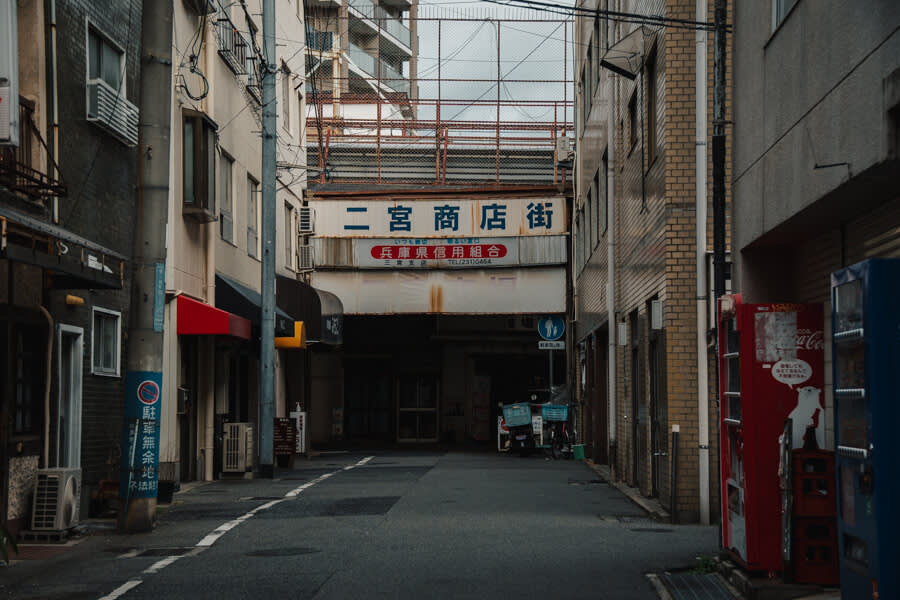
Twenty-six years in this spot. The neighborhood has changed slowly over that time, new places have opened. But Tokutomi says he has no particular drive to “actively revitalize” the area.
“I look at it more from the outside, I guess. The generational gap. The young ones are amazing. I’ll welcome them if they come, but I’m not going out of my way to make friends.”
Ninomiya isn’t a “scene” — it’s a neighborhood. The local elderly still wander through. He doesn’t want to do anything that would make them uncomfortable.
“I’d hate for people to feel like it suddenly got overrun with young people. More than ‘revitalizing’ it, I just want it to naturally get livelier in its own way.”
Over the years, outside event companies have shown up repeatedly, saying they want to “energize” the area. But the pattern is always the same: start with a litter pickup, hold one event, nobody around them gets on board, it fades out. He’s seen it happen many times.
“Rather than forcing it to get lively, if young people do their thing and it naturally gets more energetic — that’s fine. That’s not something to resist. Just let it happen naturally.”
A spot where the local grandparents gather, a place the young crowd heads to. Not just food and drink — a stylish clothing shop could be good, or even some random billiard hall or arcade.
“Everyone always wants to open some trendy bar-style place. And then another one just like it opens again.”
He laughs as he says it — the laugh of someone who’s watched this neighborhood for twenty-six years.
“Status quo is the goal. Honestly, I don’t know when to stop.”
His kids are still in elementary school. He can’t afford to collapse. Food costs are up, he has to take care of his body.
“When I was young I’d organize events and throw myself into things. I don’t have that energy anymore. All I can do now is watch the young ones go for it. As the village elder.”
The village elder — that’s how he describes himself. And then, with a laugh, he added:
“If something comes up, come ask me. Money, people — nothing but failure. I’ve had the best and worst of it when it comes to people, but now I’ve got the best staff.”
Even with nothing but failures, if you keep going —
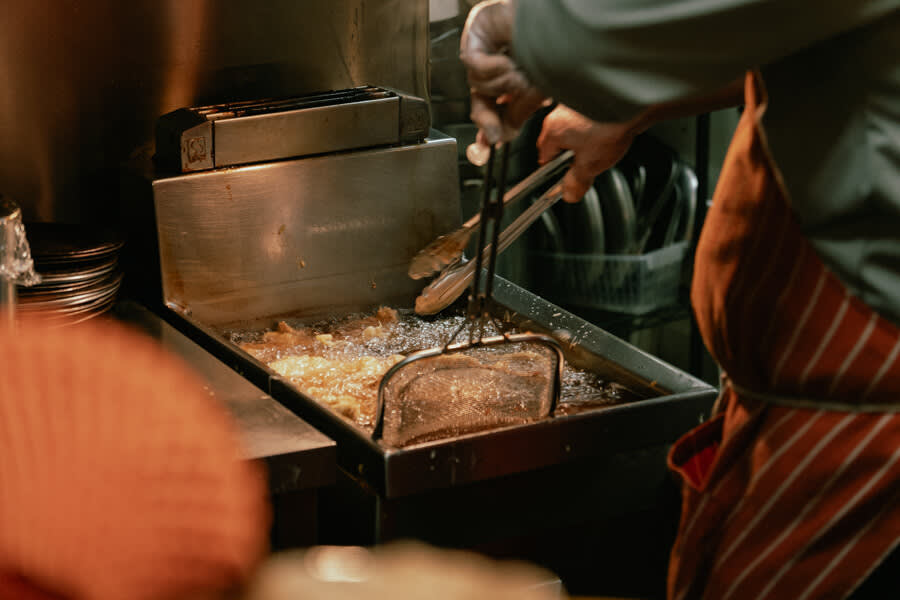
In a neighborhood that keeps changing, he’s been frying that chicken nanban for 26 years.
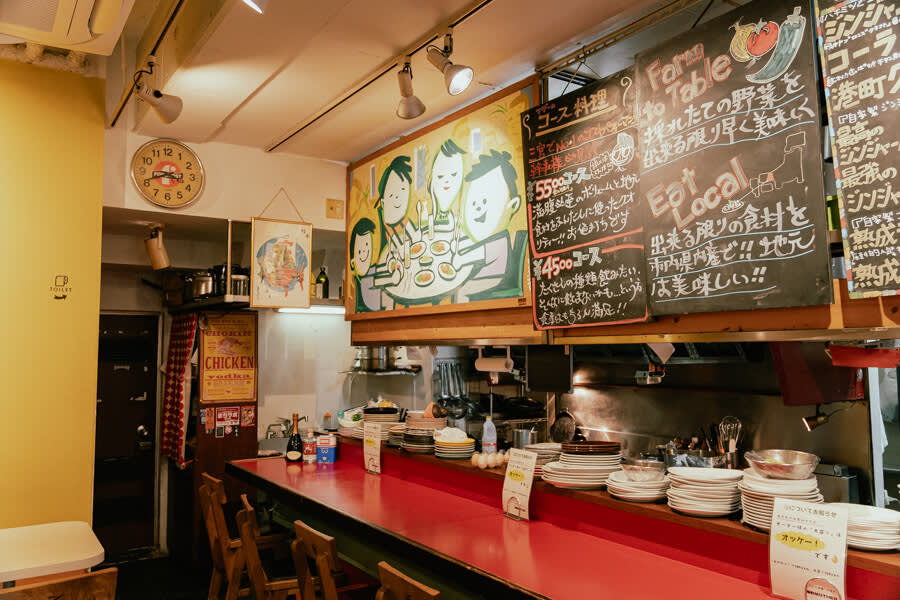
Today, behind the red counter, Tokutomi is still at his post.

Minatomachi MOTHER
- 📍 5-7-4 Kotonocho, Chuo-ku, Kobe, Hyogo
- 🚃 3 min walk from JR Sannomiya Station East Exit
- ⏰ Hours:
- Lunch 11:30–14:30 (L.O. 14:00)
- Dinner 18:00–22:00 (L.O. 21:30)
- 🗓 Closed: Thursday dinners / Sundays irregular
- 📱 Instagram: @minatomachi_mother
- 💻 Website: https://www.minatomachimother.com/
View Minatomachi MOTHER on Tabelog
View Minatomachi MOTHER on HOTPEPPER
You Might Also Like





With thanks to: Minatomachi MOTHER
This article contains affiliate links.
Featured Events in Kobe
Highlighted events taking place in Kobe

The 2nd Honeybee Marche 2026
Held on March 7–8 to celebrate Honeybee Day, the 2nd Honeybee Marche will take place at the Fountain Plaza in Suma Rikyu Park. Visitors can enjoy seeing, eating…

Kobe Port Weekend Fireworks – Mar 7, 2026 | A Spring Night Show by the Harbor
A small weekend fireworks event lighting up Kobe's night sky. Fireworks bloom for about five minutes over the sea near Meriken Park and other waterfront spots, …
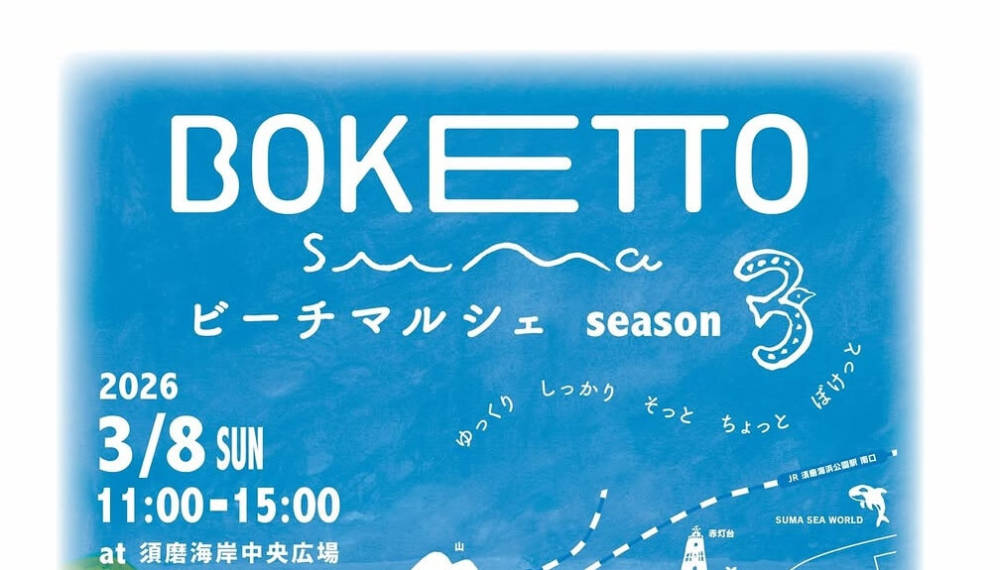
BOKETTO Beach Marche Season 3
A relaxed beachside market at Suma Beach focused on eating, shopping, learning, and thinking together. Beyond food and shopping, it promotes environmental aware…

Takatoriyama PLAY PARK (Mar 8)
Before hiking, coffee will be served at Kobe Coffee Kamikeda to visitors who bring their own bottle or purchase an original Kobe Coffee bottle. Just add hot wat…

Tekuteku Bread Festival (14th Edition)
Now in its 14th year, this popular bread festival brings together around 50 bakeries, mainly from the Kansai region and beyond — including shops from Osaka, Hyo…
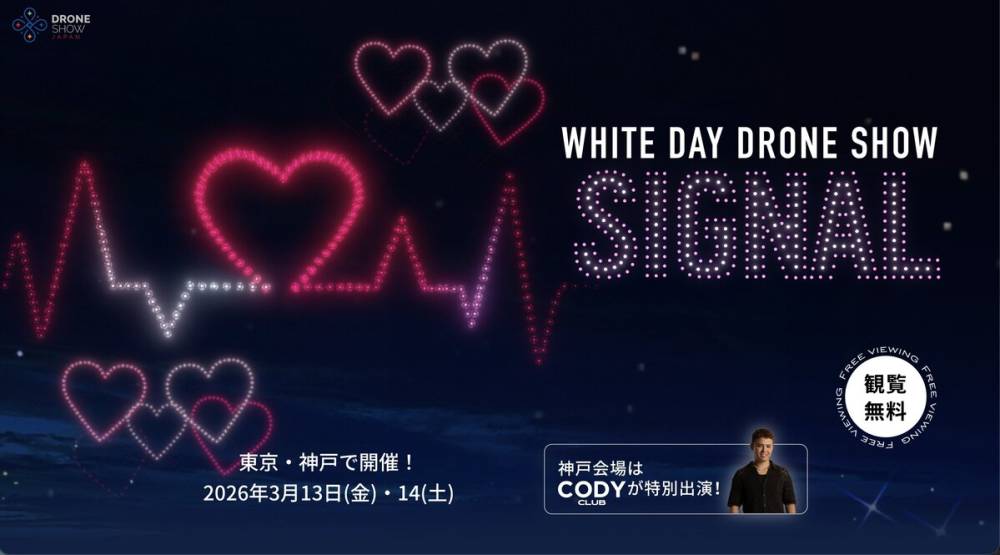
WHITE DAY DRONE SHOW SIGNAL by KOBE Night Canvas
A White Day drone art show lighting up the night sky above Meriken Park with hundreds of coordinated drones. The Kobe performance is accompanied by a live set f…